
Bathroom grab bar installation provides dependable handholds for people who want stability while bathing, using the toilet, or moving through other areas of the bathroom.
Proper bathroom grab bar installation can assist older adults, people with disabilities, individuals recovering from surgery, and anyone planning ahead for changing mobility.

For the quickest estimate, use one of three options:
1. Fill out the Contact Form to the right and upload images
2. Email photographs of the bathroom and proposed bathroom grab bar installation areas to info@atlantahomemods.com.
3. Send images via text message to (770) 880-3405
Include the number of bars requested, preferred finish, project address, name, and telephone number. Wide photographs help us understand the overall layout, while closer images show the walls, fixtures, and potential mounting locations.

As a planning guideline, we commonly recommend at least one bar adjacent to a toilet, two bars inside a shower, and two bars in a bathtub and shower combination. The final bathroom grab bar installation plan should reflect the user’s movements, abilities, and bathroom configuration. APAMedical says,
“A grab bar in the wrong place offers little protection. Being in the right place can prevent a serious fall. The difference comes down to placement — knowing exactly where to mount a bar based on how the body moves in each situation.”
Choosing Placement, Length, and Orientation
Grab bars are commonly installed horizontally, vertically, or diagonally. Horizontal bars provide support across a broader area and can be useful while moving along a wall. Vertical bars offer support at multiple gripping heights and are frequently helpful near shower or tub entrances. Angled bars may follow the natural motion of the arm during certain sit-to-stand movements.
Where Bathroom Grab Bars Are Installed
Grab Bars in the Water Closet Area

Bathroom grab bar installation beside the toilet can assist while lowering onto the seat, rising to stand, adjusting clothing, or transferring from a wheelchair. A horizontal side-wall bar may offer continuous support through several stages of movement. Depending on the room and user, a vertical or fold-down bar may provide another helpful option.
- Side-wall grab bar: A horizontal bar beside the toilet provides support when sitting down or rising from the seat. Its position should be based on the user’s reach, movement, and bathroom layout.
- Opposite-side support: When support is needed on both sides of the toilet, options may include a fold-down grab bar, floor-to-ceiling support pole, or properly secured toilet safety frame.
Placement should consider the user’s height, reach, stronger side, and usual transfer method. The toilet’s location, wall width, cabinetry, paper holder, and nearby fixtures also affect the available space. The bar should be reachable without requiring excessive twisting or leaning.
Grab Bar Placement Inside a Shower

Grab bars for showers can assist with entering, exiting, standing, turning, and moving to or from a shower seat. Many showers benefit from two or more bars because the user may need support at several points. A vertical bar near the entrance can help when crossing the threshold. A horizontal bar on a side or back wall can provide a handhold while standing or bathing.
A standard shower usually benefits from at least two grab bars. Depending on the shower’s size and the user’s mobility needs, three or four bars may provide more useful support.
- Entrance bar: A short vertical bar, typically 12–18 inches long, can provide a convenient handhold when entering or leaving the shower.
- Side-wall bar: A horizontal bar along the side wall can provide steady support while standing, turning, and bathing.
- Back-wall bar: In a larger shower, a horizontal bar on the back wall can provide an additional handhold for someone with balance or mobility challenges.
- Shower-seat bar: When a shower seat is used, an additional bar should be positioned on an adjacent wall where the seated user can reach it comfortably.
Angled bars may assist some people when transitioning between sitting and standing, although an angled position is not universally better. Orientation should reflect the user’s reach and movement. Shower controls, doors, curtains, niches, benches, handheld showerheads, and soap dishes must also be considered so the bar remains accessible without interfering with other features.
Grab Bars for a Bathtub and Shower Combination

A tub and shower combination can be especially challenging because the user must step over the tub wall while balancing on a potentially wet surface. One bar near the entrance may assist while stepping into or out of the tub. Another bar along the side or back wall may provide support while standing, bathing, or lowering onto a bath seat.
Placement should follow the person’s actual sequence of movement. A bar that is too high, low, or distant from the tub entrance may offer little practical benefit. Sliding doors, curtain rods, faucets, controls, and the wall structure affect the possible locations.
- For an accessible tub and shower combination, ADA standards specify one or two horizontal grab bars on the back wall: One bar positioned 8–10 inches above the bathtub rim. A second bar positioned 33–36 inches above the bathroom floor
- Additional vertical support may be installed on the control wall near the faucet, helping the user maintain balance while entering the tub or adjusting the water. In a private home, placement should be tailored to the user’s reach, movement, and mobility needs.
If crossing the tub wall remains difficult despite bathroom grab bar installation, a transfer bench, handheld showerhead, tub modification, or accessible shower may be more appropriate. Grab bars are valuable supports, but they cannot overcome every physical barrier.
Installing Grab Bars in Tile and Natural Stone
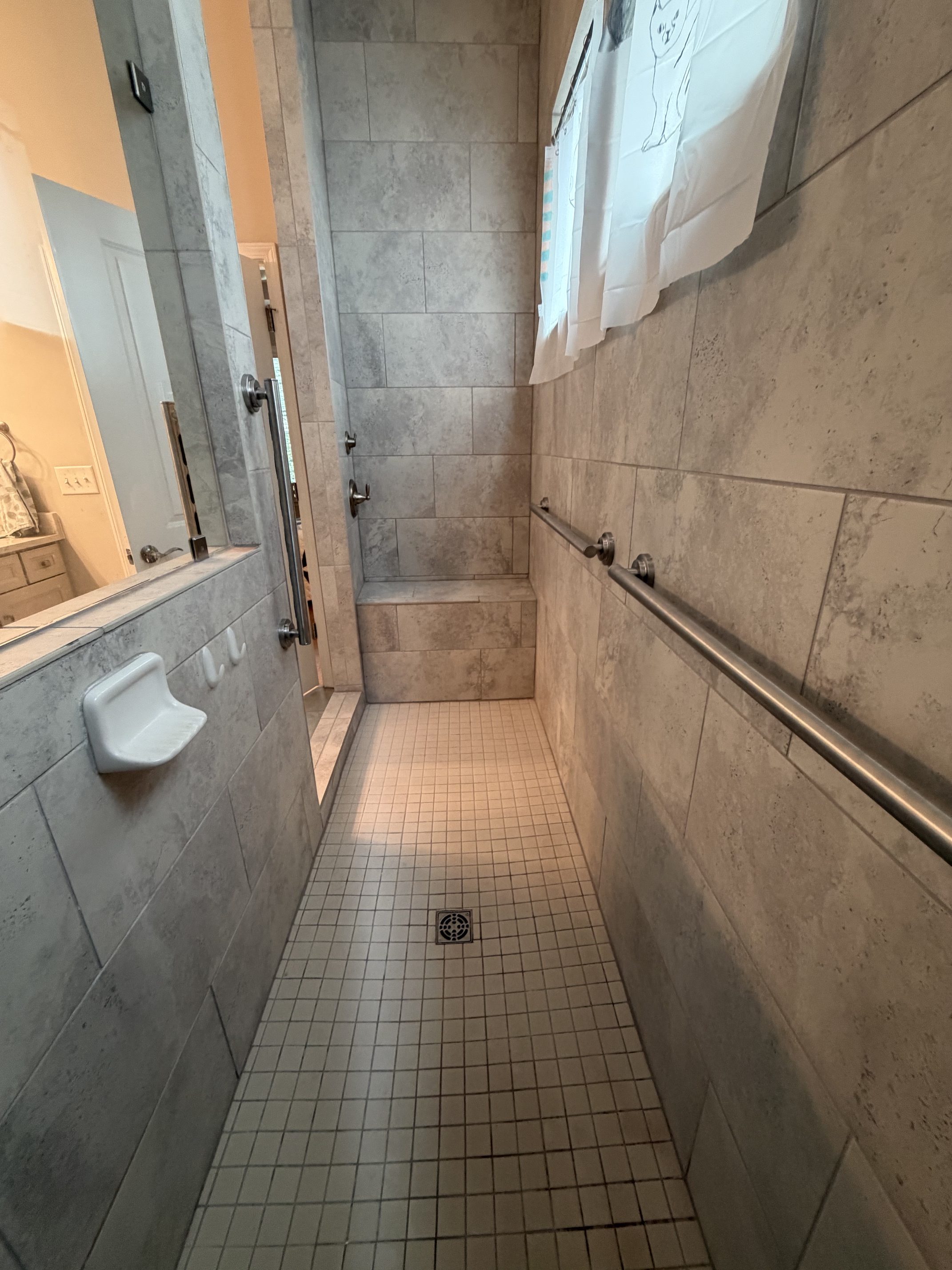
Ceramic tile, porcelain, marble, and other stone surfaces require suitable drill bits, careful hole placement, and controlled drilling. The installer must reduce the risk of cracking while identifying an appropriate structural attachment behind the finish. Natural stone and particularly hard porcelain may require additional time and specialized equipment.
Before drilling begins, the installer should evaluate the proposed locations for wall studs, plumbing lines, electrical wiring, and other concealed obstructions. Tile itself should not be treated as the primary structural support for a grab bar. The bar must be secured to suitable framing, blocking, or an approved anchoring system compatible with the wall assembly.
The condition of the tile is also important. Loose, hollow, damaged, or previously cracked tile may require further evaluation before installation. Mounting holes must be accurately aligned with the grab-bar flanges, and excessive pressure should be avoided when tightening the fasteners.
After the bar is secured, penetrations should be properly sealed to help prevent moisture from entering the wall. Professional installation helps protect the finished surface while providing secure, properly positioned support.
Installing Grab Bars in Drywall / Sheetrock
When possible, bars may be fastened into wood studs or suitable blocking behind drywall. Stud locations do not always correspond with the position that best serves the user. In some approved conditions, specialized grab-bar anchors and hardware such as Moen SecureMount (see below) can create structural mounting points where direct stud attachment is unavailable.
Installing Grab Bars in Fiberglass and Acrylic Enclosures
Fiberglass and acrylic surrounds are usually separated from the wall framing by a hollow space. Fasteners should not simply be tightened against the thin enclosure because the material can flex, crack, or collapse. Bathroom grab bar installation in these surrounds requires hardware designed to bridge the gap and transfer forces to an approved substrate or structural framing. (See SolidMount information below)
The installer should verify the surround thickness, distance to framing, stud locations, hidden plumbing, and condition of the material before selecting a mounting method.
Secure Mounting Methods and Hardware
Moen SecureMount Anchors

Moen SecureMount anchors can allow bathroom grab bar installation where studs are not available at the desired locations. The system creates mounting points behind certain approved substrates, including specified drywall assemblies and fiberglass tub surrounds. According to Moen, SMA1000 anchors support users weighing up to 300 pounds when installed correctly in an approved substrate.
SecureMount installation requires a 1¼-inch opening at each anchor and 3½ inches of clear space behind the wall. Wall thickness, plumbing, wiring, and cavity conditions must therefore be evaluated. Moen states that the anchors meet or exceed applicable ADA, ANSI A117.1, ASTM F446, and CSA requirements.
Solid Mount Hardware for Fiberglass

Solid Mount hardware is designed specifically for attaching grab bars in fiberglass and acrylic shower or tub enclosures in wood-framed homes. The system anchors into wood studs and uses adjustable components to bridge the open space between the surround and framing. This helps prevent the enclosure from flexing or collapsing as the hardware is tightened.
The manufacturer states that properly installed Solid Mount hardware has been independently tested to exceed 300 pounds of pull-out strength (ADA minimum standard is 250 pounds of force). Its suitability depends on locating accessible wood studs and confirming that the wall depth fits the hardware’s specifications.
Selecting Moen Grab Bars
Moen offers grab bars in numerous lengths, configurations, and finishes. Options may include chrome, brushed nickel, matte black, bronze, and other designer finishes that coordinate with bathroom fixtures. Certain models include textured gripping surfaces or grip pads, while others emphasize streamlined styling.
Many Moen models are constructed from stainless steel, resist corrosion, support up to 500 pounds, and comply with ADA specifications when properly installed. Specifications and ratings vary, so the documentation for the exact model should be reviewed.
What Affects Grab Bar Installation Pricing?
Bathroom grab bar installation pricing varies according to the details of each project:
- Number of bars: Multiple installations require additional products and labor, although completing several during one visit may reduce the cost per bar.
- Product selection: Length, finish, configuration, grip features, and designer styling affect material prices.
- Wall material: Drywall, ceramic tile, porcelain, natural stone, fiberglass, and acrylic require different tools and preparation.
- Mounting method: Direct stud fastening and specialized anchoring systems involve different hardware and installation steps.
- Site conditions: Limited working space, unusually hard materials, concealed obstacles, or damaged surfaces may affect the work.
- Travel distance: Homes outside the central service area may have an additional travel charge, which should be identified in the estimate.
Atlanta Bathroom Grab Bar Installation Service Areas
Grab Bars Atlanta provides bathroom grab bar installation throughout North Metro Atlanta and North Georgia. Our service area includes Hall, Gwinnett, Forsyth, Fulton, Cobb, Cherokee, Barrow, Jackson, Oconee, and Clarke counties.
Communities regularly served include Gainesville, Flowery Branch, Buford, Suwanee, Cumming, Alpharetta, Johns Creek, Lawrenceville, Marietta, Roswell, Braselton, Jefferson, Athens, and surrounding areas. Include the complete project address when requesting an estimate so we can confirm availability and any applicable travel cost.
Frequently Asked Questions
How many bathroom grab bars should be installed? The appropriate number depends on the user and bathroom. As a starting point, one bar near a toilet, two in a shower, and two in a tub/shower combination often provide support at important locations. An individual may need a different arrangement.
Can grab bars be installed without remodeling the bathroom? In many cases, yes. Professional bathroom grab bar installation can often be completed through the existing finished wall using suitable mounting methods. Installation conditions vary, and existing damage or inaccessible structure may require additional work.
Should residential grab bars follow ADA placement rules? ADA standards generally govern specified public and commercial environments rather than every private residence. Those measurements can provide useful reference information, but residential positioning should respond to the individual unless a law, program, or project requirement dictates otherwise.
Experience Supporting Aging in Place
Grab Bars Atlanta is a division of Atlanta Home Modifications, LLC. Owner Elizabeth Greenewald holds Certified Aging-in-Place Specialist training and combines architectural and home-design experience with practical knowledge of accessibility improvements. This background supports recommendations based on movement, layout, construction, and long-term use.